

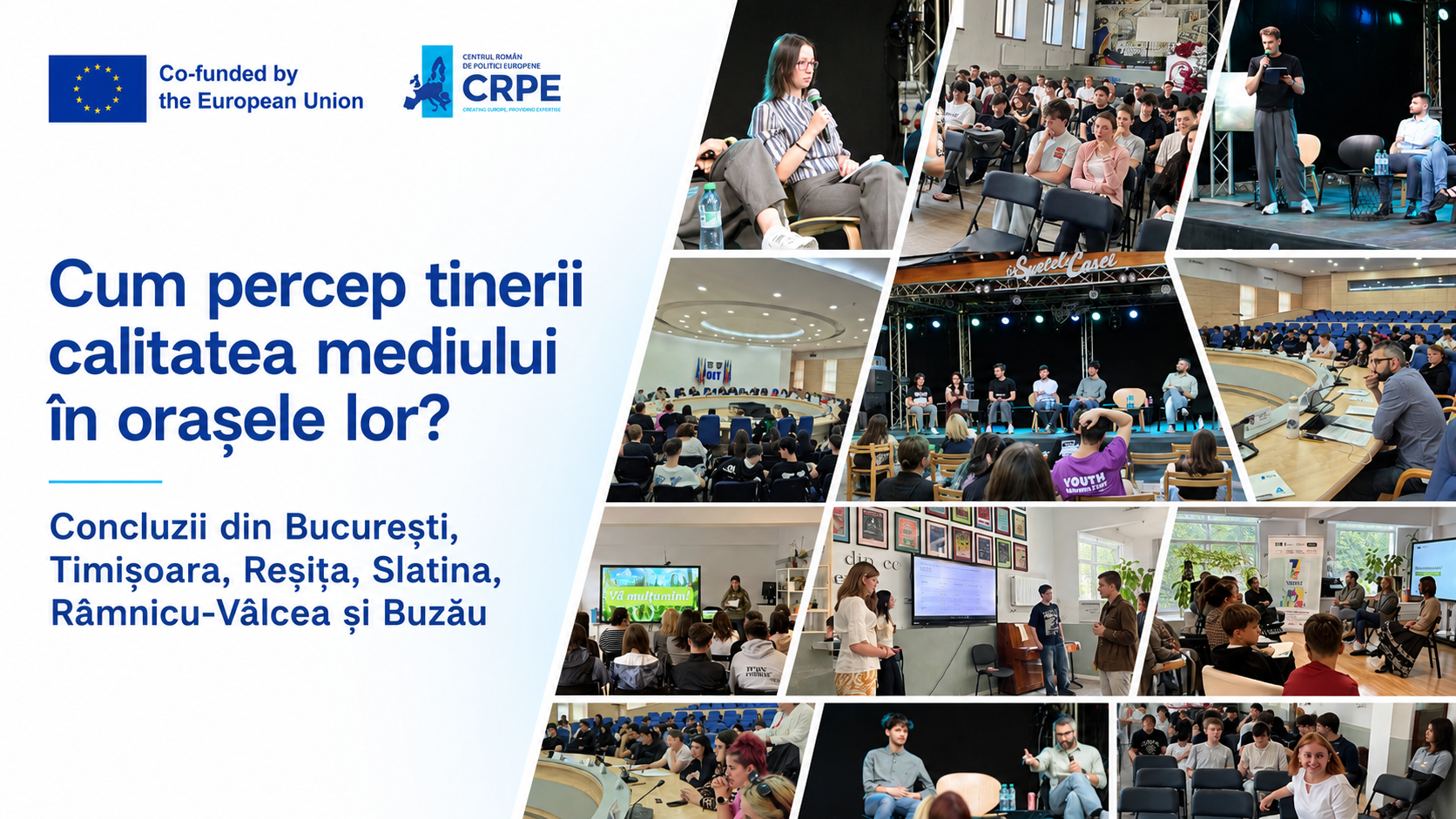
More than 500 young people involved in monitoring environmental policies
“We have seen what cities and happy places look like in other countries. Do you know what they have in common? Greenery,” Flavia, one of the participants from Timișoara, told us. Starting from this simple question, what makes a city healthier and more pleasant for its residents, CRPE organised 12 workshops with more than 500 participants and worked for five months with 10 teams of young people from Bucharest, Timișoara, Reșița, Slatina, Râmnicu-Vâlcea and Buzău.
The project aimed to turn concern for the environment into a practical exercise in civic engagement. The young people analysed information on air pollution, waste management and green spaces, identified the institutions responsible and assessed how easily a citizen can find out what is happening in their city and monitor the activity of public authorities.
What we found: The data exists, but it is difficult to find and understand
One of the main conclusions of the exercise is that access to information on environmental quality remains difficult. Data is often scattered across several institutions, published in difficult-to-use formats or presented in excessively technical language. The most difficult information to access concerns waste traceability and the situation of green spaces.
There are also problems with monitoring. Air quality is measured through a limited national network of monitoring stations, which do not always operate under optimal conditions. Three of the six cities analysed do not have additional local monitoring networks. Bucharest, Timișoara and Râmnicu-Vâlcea also benefit from their own measurement systems, developed as a result of civil society initiatives. Road traffic continues to be the largest contributor to declining air quality, accounting for more than 60% of pollutant emissions in Bucharest.
In the case of green spaces, many local administrations cannot even provide an exact figure for the area they have available. Green Space Registers are rarely updated, and in some cases they do not provide information that can be effectively used for planning and monitoring. The lack of complete data makes it difficult to assess progress and establish clear objectives for expanding green areas.
Monitoring waste management has also proved difficult. In all the cities analysed, recycling rates are below 10%, and a large proportion of waste continues to end up in landfills. Separate waste collection is insufficiently developed, while sorting systems are limited in some cases. For example, Timișoara collects waste in only two fractions.
Strategic planning remains limited
The young people identified another problem: the existence of a large number of strategies and plans that are not always aligned with one another. Local development strategies, energy and climate plans, sectoral strategies and Green City Action Plans often coexist without a unified vision. In addition, some essential documents are missing or have not been updated. Bucharest still does not have an Integrated Air Quality Plan, despite having been condemned by the Court of Justice of the European Union for exceeding pollution limits. Timișoara does not have a Green Space Strategy that complies with legal requirements, while Râmnicu-Vâlcea does not have an updated Air Quality Maintenance Plan.
What young people recommend for greener and healthier cities
The youths believe that the first step is to improve transparency and access to information. They propose creating single platforms (urban dashboards) where citizens can find up-to-date data on air quality, green spaces and waste management, as well as simple tools for monitoring the progress of public authorities.
They support expanding pedestrian areas and limiting car traffic around schools, increasing green spaces and using nature-based solutions that are easier to maintain and more effective for adapting to climate change. They also call for a more transparent waste management system, expanding the “pay-as-you-throw” principle and promoting the circular economy.
Introducing educational measures, such as installing pollution monitoring sensors in schools, developing community gardens and expanding composting infrastructure, would help increase civic engagement and improve environmental quality.
10 reports exploring urban environmental quality
Environmental Quality: Lessons from 6 Cities and 10 Civic Monitoring Exercises
Environmental Quality in the Municipality of Bucharest: air quality and energy efficiency
Environmental Quality in the Municipality of Timișoara: air quality, waste management and green spaces and urban regeneration
Environmental Quality in the Municipality of Râmnicu-Vâlcea: air quality and green spaces and biodiversity
Environmental Quality in the Municipality of Slatina: air quality
Environmental Quality in the Municipality of Buzău: air quality
Environmental Quality in the Municipality of Reșița: air quality
Reports published as part of the “Youth for Green Romania” project (2024-3-RO01-KA154-YOU-000285479), implemented by the Romanian Center for European Policies.
The content of this material is the sole responsibility of the authors, and the National Agency and the European Commission are not responsible for how the information contained herein may be used.