Romania has made significant progress in recognising children’s right to participate in public decisions that affect them. The adoption of Law No. 295/2024 marks an important change in the national legislative framework, introducing, for the first time, explicit obligations for public authorities to consult children aged 14 to 18 and establish permanent participation mechanisms. However, the existence of a legal framework does not guarantee its implementation, and children’s participation in decision-making remains limited, uneven and often dependent on individual initiatives or civil society projects.
Until recently, children’s participation in public life was mainly regulated by youth legislation, particularly Law No. 350/2006, which recognises the right of people aged 14 to 35 to engage in public life and establishes consultation obligations for public authorities. At the same time, student participation has been strengthened through representation mechanisms in schools, student councils and consultative structures at county and national levels.
The adoption of Law No. 295/2024 changes this approach by recognising children’s participation as a distinct right that must also be respected outside the education system. Since 2025, Parliament, the Government, the Presidential Administration, local authorities and public institutions under their authority or coordination have been required to organise at least one annual consultation session with children. The law also provides for the establishment of permanent consultation mechanisms, the appointment of staff responsible for coordinating children’s participation, and the publication of information on participation opportunities in a format accessible to children.
This is an important step for Romania, which is among the few countries with a legislative framework specifically addressing children’s participation in public decision-making beyond the education sector. However, this development also raises several questions: To what extent are public institutions prepared to implement these new obligations? What participation mechanisms already exist, and how accessible are they? And, above all, to what extent do children’s views actually influence decisions affecting their lives?
How do children participate in public decision-making in Romania? What we analysed
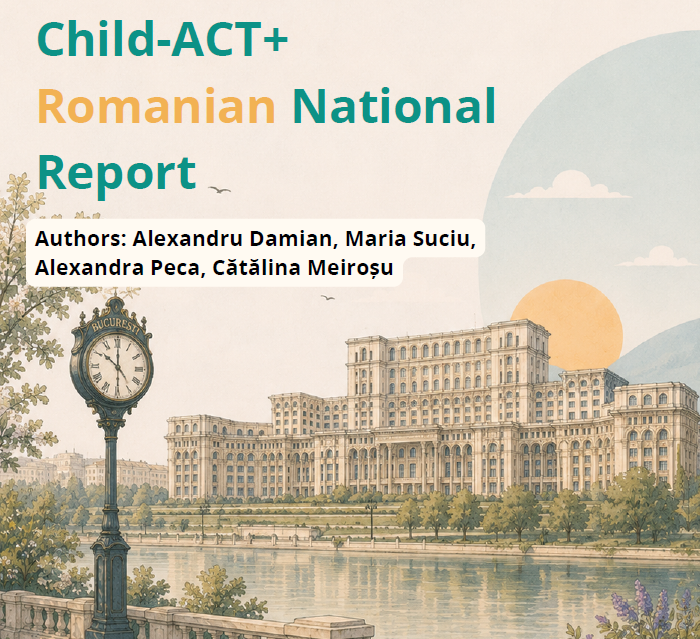
As part of the European ChildACT+ project, we produced a national report on children’s participation in decision-making in Romania, examining both the evolution of the legislative and institutional framework and the experiences of children and organisations working to promote their rights.
Our aim was to understand how the right to participation translates into everyday life, what opportunities children have to express their views in schools and their communities, and to what extent public institutions have the mechanisms, resources and capacity needed to involve them in decision-making.
The research combines an analysis of legislation and public policies with interviews, consultations with organisations and children’s representatives, and an assessment of institutional practices. We conducted 14 interviews with children aged 16 to 18 from Bucharest, Dorohoi and Sascut, capturing experiences from both urban and rural communities, as well as interviews with teachers and professionals involved in supporting children’s participation.
With support from GEYC, we organised a focus group with nine representatives of organisations and children’s participation structures, including NGOs, international organisations and student council representatives. The discussions focused on identifying the main implementation challenges, examples of good practice and measures needed to strengthen children’s participation.
In addition, we submitted 70 freedom of information requests to local and central authorities to examine the existence of consultation mechanisms, how they operate and the measures adopted to implement the new legal obligations. We received responses from 14 public institutions, which limited the possibility of a systematic assessment but also highlighted the difficulties of documenting and monitoring children’s participation at the institutional level.
What the research tells us: an ambitious legislative framework, but participation remains limited
The report’s main finding is that Romania now has a relatively comprehensive legislative framework for the participation of children and young people, but its implementation remains uneven and largely dependent on political will, institutional capacity and the involvement of civil society organisations.
Although legislation establishes consultation obligations, there is still no national monitoring system to assess whether authorities comply with them. The methodological guidelines adopted in 2025 provide instructions for organising and reporting consultations but do not establish a mechanism for overseeing and evaluating the law’s implementation. Without common indicators, regular assessments and publicly available data, it is difficult to determine not only how many institutions consult children, but also whether these consultations have any impact on public decisions.
Interviews with children also reveal a significant gap between participation in schools and involvement in community-level decisions. Student councils and school-based consultations are much better known and more accessible, while opportunities to participate in local government decision-making remain largely invisible. Of the 14 children interviewed, only one had participated in a public consultation, none had been involved in a participatory budgeting process, and eight did not know or were unsure how to submit a proposal to local authorities.
Beyond access to participation mechanisms, children highlighted another important issue: the difference between being asked for an opinion and actually being listened to. Eleven of the 14 participants felt that local authorities rarely consult children or do so only after decisions have already been made. Moreover, they rarely receive information about what happens to their proposals or why certain ideas are accepted or rejected.
“We are heard, but not always listened to,” one of the children interviewed told us. This observation captures one of the central issues identified in the research: participation cannot be reduced to simply having the opportunity to express an opinion. It also requires mechanisms to ensure that children’s views are genuinely taken into account.
The report also highlights significant inequalities between communities. Children in rural and disadvantaged communities have access to fewer participation opportunities, less information and weaker institutional support. At the same time, the legislative framework does not include sufficient targeted measures to ensure the participation of children facing social, economic, geographical or disability-related barriers.
There are models that work. How can they become common practice?
In recent years, several local authorities, in partnership with civil society organisations, have developed participation mechanisms demonstrating that children can be involved in community decisions beyond one-off consultations.
UNICEF’s Child Friendly Cities Initiative, participatory budgeting programmes for secondary school students, such as the one launched in Timișoara in 2025, and Com’ON initiatives provide examples of how children and young people can be involved in identifying local problems, developing proposals, setting priorities and implementing projects.
These examples show that participation becomes more meaningful when children are involved throughout the decision-making process, rather than being consulted at a single stage. However, many of these initiatives depend on external funding, NGO involvement or the commitment of individual local government representatives. They remain concentrated mainly in larger cities with greater administrative and financial resources and have yet to become a widespread institutional practice at national level.
From legal obligations to participation mechanisms that work
The challenge for Romania is no longer simply to recognise children’s right to participate in public decisions, but to create the conditions for this right to be meaningfully exercised in all communities.
The report recommends developing a national mechanism to monitor and evaluate the implementation of the legislation, with common indicators, public reporting and clearly defined institutional responsibilities. It also highlights the need for dedicated and predictable funding, support for local authorities with limited administrative capacity, and the expansion of participation mechanisms that have already demonstrated their value.
Above all, children’s participation must be integrated into the entire process of developing and implementing public policies, from identifying problems and formulating solutions to evaluating results. Consultation should not be an isolated exercise carried out merely to fulfil an administrative obligation, but an integral part of how public institutions make decisions.
The coming years will be decisive in determining whether Law No. 295/2024 can transform currently isolated examples of good practice into permanent participation mechanisms accessible to children in all communities. To achieve this, authorities must not only create opportunities for children to express their views, but also demonstrate how their contributions influence public decisions.
The full report is available here.
Funded by the European Union. Views and opinions expressed are, however, those of the author(s) only and do not necessarily reflect those of the European Union or the European Education and Culture Executive Agency (EACEA). Neither the European Union nor the granting authority can be held responsible for them.