

Democratic societies cannot function without civically engaged citizens who understand how they can participate in and influence public decision-making. Civic activism and democratic culture are not sufficiently encouraged and are often actively constrained. This is part of a broader context of democratic backsliding and declining trust in the ability of public participation to bring about change. In recent international assessments, Romania is classified somewhere between a “flawed democracy” and a “hybrid regime” (EIU, Democracy Index 2025–2026), and is also experiencing a process of “autocratization” (V-Dem, 2026).
Youth civic participation remains limited in Romania, particularly in rural areas and small towns, where opportunities for involvement are often scarce. As a result, young people rarely use civic participation tools, which they are often unfamiliar with in the first place. They have limited opportunities to put civic education into practice and rarely interact with local authorities.
Level UP Democracy: From gamification to real decisions in the community
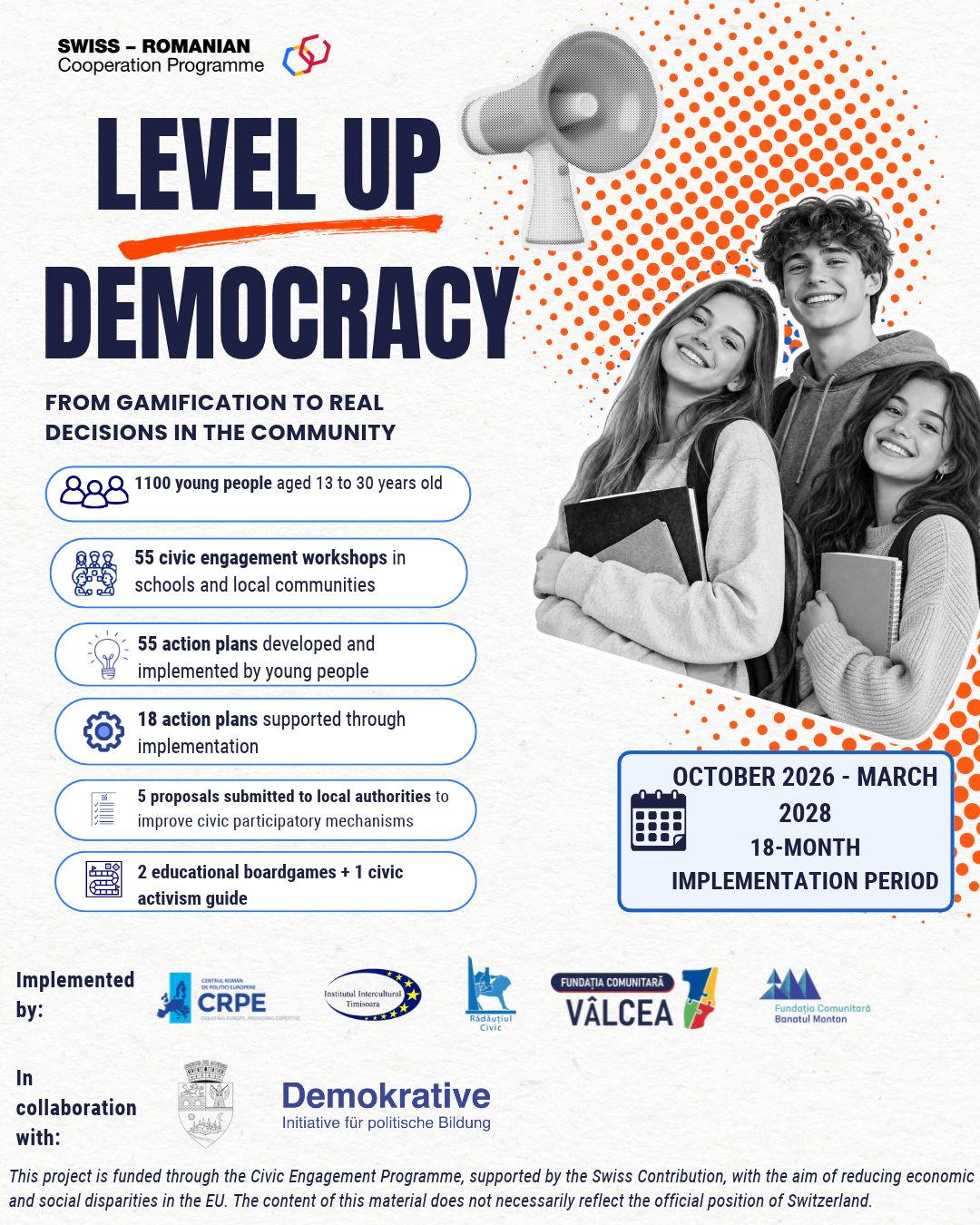
Against this backdrop, CRPE is launching Level UP Democracy: From gamification to real decisions in the community, an initiative aimed at developing young people’s civic skills and encouraging their participation in community life through non-formal education, gamification and dialogue with local public authorities. The project targets young people aged 13 to 30, particularly those from rural areas, small towns and inclusive educational settings, across at least 10 counties in Romania.
The project will run from October 2026 to March 2028, in partnership with the Banatul Montan Community Foundation, Rădăuțiul Civic Association, Vâlcea Community Foundation and the Intercultural Institute of Timișoara. Timișoara City Hall and the Swiss organisation Demokrative are contributing as collaborators, bringing their expertise in civic participation, democratic education and citizen engagement mechanisms.
How we plan to strengthen civic engagement
- Developing a civic engagement toolkit: We will adapt and continue using the ElectionVille and EcoVille educational games, complemented by practical guides and 10 new scenarios for civic engagement. These resources will help participants understand how public institutions work, what tools are available for civic participation and how local decision-making processes function.
- Civic education workshops: We will work with at least 55 schools and local NGOs and organise at least 55 workshops for 1,100 young people. At least half of the participating organisations will come from rural areas, small towns or inclusive educational settings. The institutions involved will also receive the educational materials for further use.
- Youth-led civic initiatives: Young people will develop at least 55 local action plans, 18 of which will receive mentoring and support for implementation. Particular attention will be given to social inclusion and climate change, which will feature in at least 15 of the proposed action plans.
- Local-level dialogue and advocacy: We will organise workshops and meetings with public authorities, both in partner communities and online, to identify barriers to participation, facilitate dialogue between young people and authorities, and work together with local administrations to develop effective participatory mechanisms. This process will also result in at least 5 proposals for improving civic participation mechanisms, which will be submitted to local authorities.
- Exchanging experiences and promoting results: We will organise two online civic marathons. The first will showcase the initiatives developed by students and young people throughout the project, while the second will focus on dialogue with local administrations to improve civic participation tools.
Why does civic engagement matter?
Let’s repeat what we wrote at the beginning, especially if you’ve made it this far. Democratic societies need civically engaged citizens who know how to use the available participation tools and understand how they can help improve public decision-making.
This project is funded through the Civic Engagement Programme, supported by the Swiss Contribution, with the aim of reducing economic and social disparities in the EU. The content of this material does not necessarily reflect the official position of Switzerland.