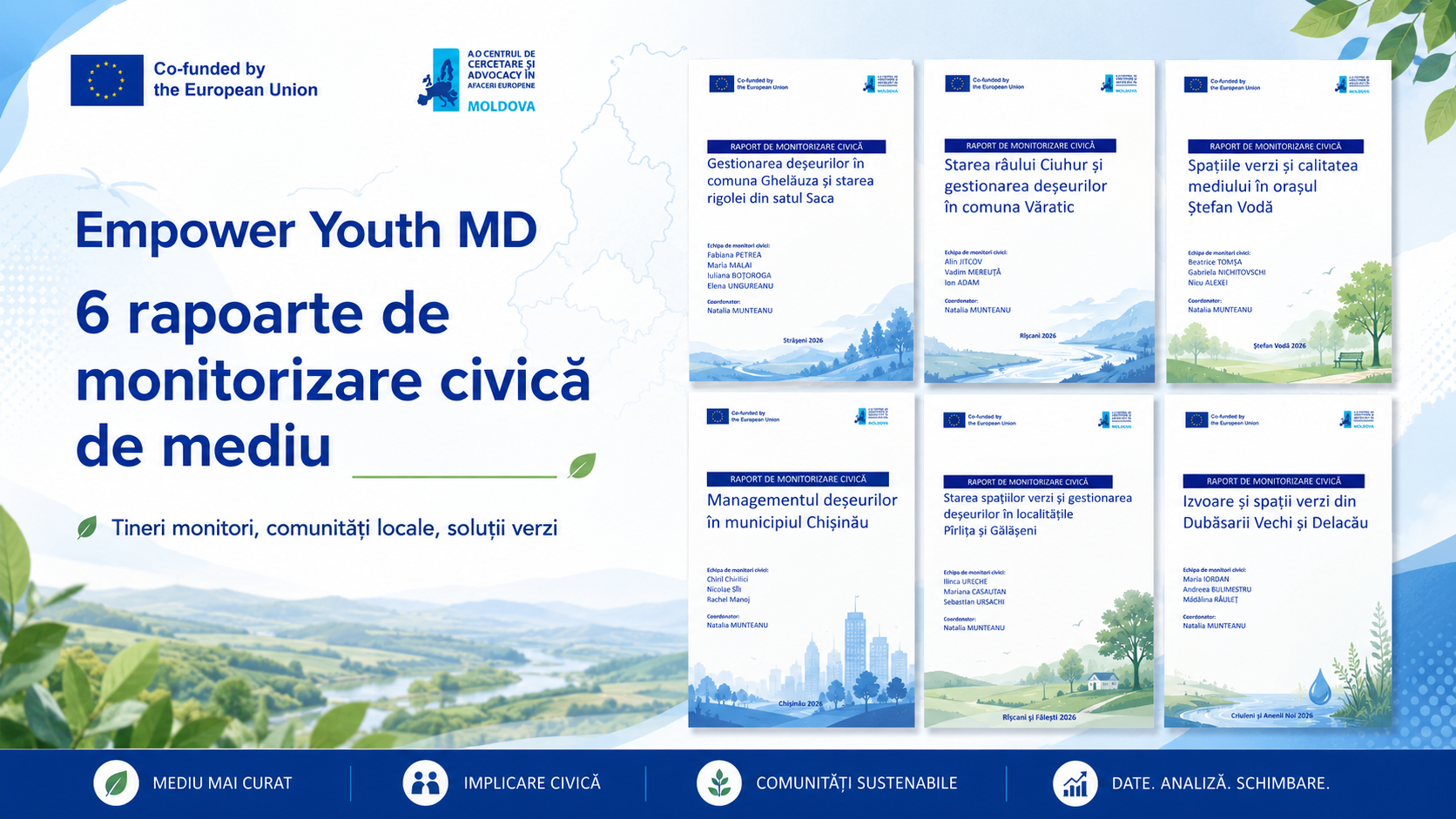
EmpowerYouth was implemented by six teams of young people from the Republic of Moldova, who were trained and mentored by the CRPE team in Chișinău and worked in local communities across the country. They successfully carried out their mission: they analysed environmental issues in their communities and examined how local authorities identify and implement solutions.
The civic monitoring programme developed as part of EmpowerYouth brought together young people from the municipalities of Chișinău and Bălți, the town of Ștefan Vodă, and communities across the Strășeni, Rîșcani, Fălești, Anenii Noi and Criuleni districts. The teams carried out monitoring activities in Ghelăuza and Saca, Văratic, Ștefan Vodă, Chișinău, Pîrlița and Gălășeni, as well as in Dubăsarii Vechi and Delacău. The initiative aimed to channel young people’s interest in environmental and climate issues into meaningful civic participation.
The young people analysed local documents and strategies, submitted information requests to public authorities, spoke with residents and local government representatives, conducted surveys and carried out field visits. Each team developed recommendations for local authorities and presented its findings at a best-practice workshop.
Who are the EmpowerYouth environmental monitors and what did they monitor?
- Waste management in Ghelăuza commune and the condition of the drainage ditch in Saca village
The EcoYouth Ghelăuza team monitored two important issues for Ghelăuza commune, Strășeni district: waste management and the condition of the rainwater drainage infrastructure in Saca village.
The monitoring report shows that the locality has a basic waste collection system, but infrastructure remains limited, there is no separate waste collection, and the communal landfill is not authorised in accordance with environmental regulations. Recommendations include installing separate waste collection bins, organising environmental education campaigns, upgrading the landfill, periodically clearing the drainage ditch and planting vegetation to stabilise the soil.
Ghelăuza City Hall welcomed the initiative and identified several measures that could be implemented in the short term, including information campaigns, clean-up activities and the gradual installation of additional bins and waste containers.
Full report is available here
- The condition of the Ciuhur River and waste management
The Nika Văratic team analysed the environmental situation in Văratic commune, Rîșcani district, focusing on the protection of the Ciuhur River, wastewater management, drinking water quality and the local sanitation system.
The monitoring identified pollution risks resulting from the lack of a centralised sewage system for households, waste disposal along the riverbanks, land erosion and the presence of an unauthorised local landfill near the entrance to the village. The team also analysed the quality of water from the local water supply system, finding that it was microbiologically safe but did not comply with standards for certain chemical indicators.
The young people recommend developing sewage infrastructure, conducting more frequent water quality monitoring, protecting the banks of the Ciuhur River, installing separate waste-collection containers, and more actively involving young people and citizens in public consultations and environmental activities.
Full report is available here
- Green spaces and environmental quality in the town of Ștefan Vodă
The Green Mind team monitored the management of green spaces and the implementation of local environmental policies in the town of Ștefan Vodă. Known as the “city of seven parks”, Ștefan Vodă has 47 hectares of green space and several strategic documents covering urban development, sustainable energy and climate change adaptation. The young people focused in particular on the maintenance of parks and public squares, the revitalisation of the Kizil historic centre, waste management and citizen participation.
The report identifies both positive examples — investments in Kizil Park, public consultations and cooperation between the City Hall and the Youth Centre — and problems such as uneven maintenance of green spaces, insufficiently developed separate waste collection and the gap between the objectives set out in local strategies and the pace of their implementation.
The recommendations focus on regular park maintenance, expanding separate waste collection, greater transparency regarding project budgets and timelines, and the creation of permanent mechanisms through which young people can participate in environmental decision-making.
Full report is available here
- Waste management in the municipality of Chișinău
The EcoYouth Chisinau team analysed the waste management system in the municipality of Chișinău, the functioning of separate waste collection, waste traceability and the transparency of investments in municipal infrastructure. The report shows that the municipality has an extensive collection infrastructure, with more than 1,200 collection platforms operated by the “Autosalubritate” Municipal Enterprise, more than 1,300 containers for recyclable materials, and significant investments in specialised vehicles, containers, the transfer station and the sorting line. However, separate waste collection directly from residents remains very limited compared to the total volume of municipal waste.
The team also identified problems related to outdated collection platforms, the mixing of collected waste, the illegal dumping of construction debris and bulky waste, vandalism of containers and limited youth participation in decision-making. Proposed solutions include the monthly publication of data on the routes and destinations of waste, expanding separate waste collection, using digital tools to report problems, and creating a Youth Civic Environmental Council.
Full report is available here
- Green spaces and waste management in Rîșcani district
EcoVision Balti monitored the situation in Pîrlița, Fălești district, and Gălășeni, Rîșcani district.
In Pîrlița, the team analysed the activity of the municipal sanitation service and households’ access to waste collection. The young people found that the road infrastructure limits the access of the waste collection tractor to certain areas, while the three local landfills are not authorised in accordance with environmental requirements.
In Gălășeni, the monitoring focused on both waste management and the condition of green spaces and forest areas. The team documented the existence of an unauthorised landfill and the reduction of some forested areas, but also the natural regeneration of the land where a former landfill had been located near the forest.
The report recommends developing local waste collection infrastructure, placing waste bins in accessible areas, authorising and upgrading waste disposal sites, protecting forests and more actively involving citizens in planning environmental measures. The Pîrlița and Gălășeni City Halls welcomed the monitoring exercise and stated that the recommendations would be analysed according to the priorities and resources of the communities.
Full report is available here
- Springs and green spaces in Anenii Noi district
The Garda Veche team analysed the environmental situation in Dubăsarii Vechi, Criuleni district, and Delacău, Anenii Noi district, two rural communities located near the Nistru River.
Garda Verde conducted no fewer than six field monitoring sessions, consulted residents and specialists, and analysed 11 water sources. The report addresses access to water and sanitation, the condition of springs and wells, waste management, forest protection and biodiversity.
In Delacău, where there is no centralised water supply and sewage system, springs and wells remain essential for the community. In Dubăsarii Vechi, the analyses showed significant differences between water sources, with some public wells recording elevated nitrate levels. The monitoring also identified abandoned waste in green spaces and natural areas, most of it consisting of plastic materials.
The report also highlights positive initiatives, such as the development of the park in Delacău, tree planting carried out through the “Forest Generation” Programme, the reforestation of the beach area in Dubăsarii Vechi and the modernisation of the Central Park. The team recommends regular water testing, the protection of springs, the development of sewage and wastewater treatment solutions, expanding separate waste collection and involving young people in monitoring natural resources.
Full report is available here.
From Interest to Civic Participation
The six reports show that environmental issues are closely linked to the quality of public services, access to information and citizens’ ability to participate in local decision-making. From waste collection and river protection to water quality, green spaces and climate change adaptation, young people analysed issues that directly affect the lives of their communities.
The monitoring exercise went beyond simply identifying problems. The teams engaged with authorities and citizens, documented the situation on the ground and developed solutions that can be implemented at the local level. The responses received from several city halls and public institutions show that civic monitoring can create a concrete space for dialogue between young people and decision-makers.
About EmpowerYouth
The EmpowerYouth project supports youth engagement through climate and environmental action, seen as an important starting point for more active civic participation. The lack of youth engagement in democratic processes remains a challenge both in European Union Member States and in EU neighbouring countries, despite young people’s growing interest in climate change and environmental protection.
The project aims to strengthen the capacity of at least 80 youth organisations from Romania, the Republic of Moldova, Georgia and Armenia and support local green initiatives. Through non-formal learning activities, mentoring, knowledge transfer and partnerships with civil society and public authorities, young people are provided with the tools they need to understand, monitor and influence public policies that affect them.
Co-funded by the European Union. The views and opinions expressed are solely those of the authors and do not necessarily reflect those of the European Union or the European Education and Culture Executive Agency (EACEA). Neither the European Union nor the granting authority can be held responsible for them.