

In 2025, CRPE published the first independent assessment of Romania’s Digital Decade 2030 Roadmap, finding a plan that was less a transformative digital strategy and more a formal bureaucratic compliance exercise. Simply said, a roadmap falling short of the ambition of the EU Digital Decade. We argued that Romania needed to use the 2026 revision milestone to set more ambitious and measurable targets, improve coordination, open the process to meaningful stakeholder consultation and create a proper monitoring framework. Ultimately, realising these objectives requires robust political backing and the ambition to advance the digitalisation agenda.
Romania’s Digital Decade Roadmap: Some Progress, but Greater Ambition is Needed
One year later, we are continuing this work with our second assessment of the roadmap, as part of our commitment to monitor its implementation annually throughout the Digital Decade programme. The EU framework is designed as a cycle of monitoring, recommendations and adjustment: Member States are expected to revise their national roadmaps every two years, taking into account the Commission’s recommendations and changes in their national priorities and investments.
Our 2026 assessment is not encouraging. Romania has made some progress in implementing projects included in the roadmap, but the roadmap itself has remained largely unchanged. There has been no meaningful revision, adjustment or public consultation process. Romania has failed to submit a revised roadmap up until now. This is happening despite the fact that 24 Member States had already submitted roadmap adjustments by June 2026, while the next deadline is December 2026.
Romania’s Digital Decade Roadmap needs to be revised
There are several main reasons why Romania needs to revise its Digital Decade roadmap now.
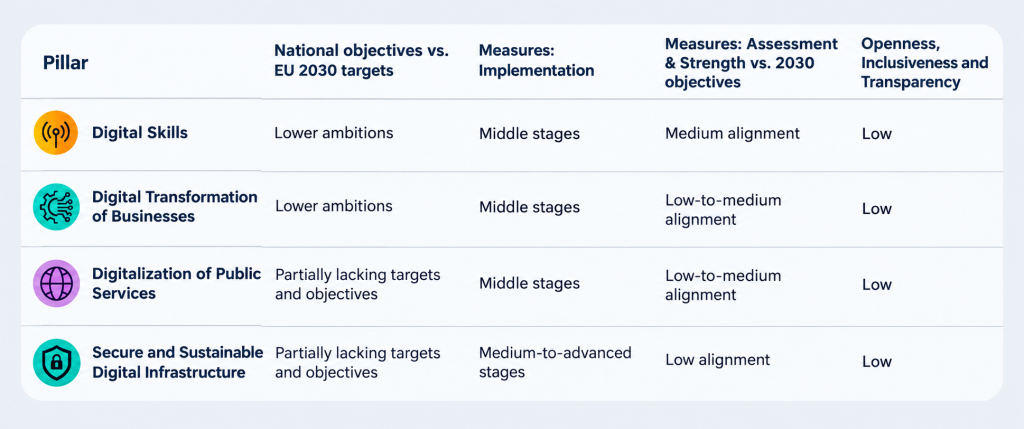
The first is the weaknesses of the initial plan itself. Our 2025 and 2026 assessments found a roadmap that fell short of functioning as a genuine national digital strategy. At the same time, Romania remains at the bottom of the EU on several important indicators, from basic digital skills and the uptake of advanced technologies by businesses to 5G connectivity, while continuing to perform strongly on only a limited number of indicators, most notably fixed connectivity infrastructure.
The second reason is the end of numerous projects and of the National Recovery and Resilience Plan (NRRP) funding cycle and the need to align new digital projects with the requirements of the Multiannual Financial Framework (MFF) 2028-2034. Romania’s roadmap relies heavily on projects financed through the NRRP, many of which reaching their end in August 2026
The third reason is that the Digital Decade framework itself is entering a redesign phase. The Commission started the process of reviewing the Digital Decade Policy Programme with a new programme expected in early to mid 2027. The review is intended to ensure that the targets and objectives continue to reflect new legislation, the rapidly evolving technological landscape and Europe’s priorities beyond 2030.
Romania’s Digital Decade Roadmap: current status
For CRPE, the key question is no longer whether Romania needs a better Digital Decade roadmap, as it does, but whether the Government and ADR will actually use the 2026 momentum to build one, or at least to start a meaningful revision process.
The current roadmap is reaching a turning point. A large part of its financial and operational basis is coming to an end, while Romania needs to decide what should replace it, which priorities should be maintained, what new investments are needed and how these should contribute to the EU’s 2030 targets. The next revision therefore cannot simply add a few new projects to the existing document. It needs to rethink the roadmap as a genuine national digital strategy, with clear priorities, realistic but ambitious targets, responsible institutions, funding, timelines and measurable results.
CRPE proposals considering Romania’s Digital Decade Roadmap
Beyond Romania’s low level of ambition and the weak alignment of its indicators with the EU’s Digital Decade 2030 goals, the main problem is that the roadmap does not function as a genuine strategy and lacks sufficient political backing. Its weak link between individual EU-funded projects and broader digital objectives makes it difficult to assess real progress. The strategy also needs much better monitoring and transparency: not only what has been funded and announced, but what has been delivered, who has benefited and whether Romania is moving closer to its 2030 targets. This should be done regularly through public dashboards and progress reports, rather than relying only on the Commission’s annual monitoring. ADR should take the lead in making this information available.
The revision is also an opportunity to finally open the process. ADR should start a genuine and transparent consultation, involving the institutions implementing the roadmap, but also civil society, business, academia, local authorities and other relevant stakeholders. The revision should not be a closed administrative exercise, but a chance to build a roadmap around Romania’s real digital priorities and challenges.