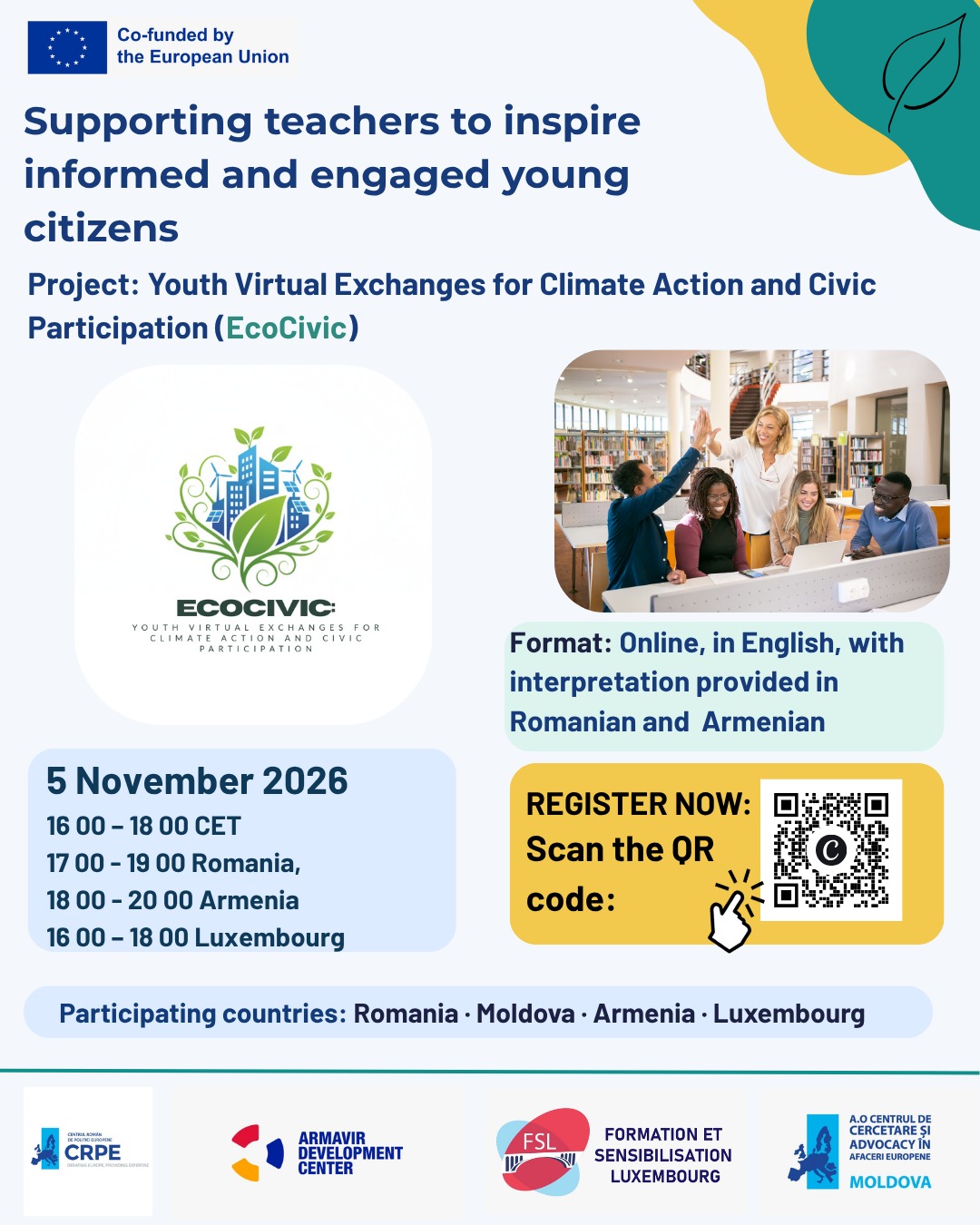
On 5 November 2026, we hosted an online event entitled ‘Supporting Teachers and Local NGOs to Foster Young People’s Civic Engagement in Schools and Communities’, as part of the EcoCivic project. Dedicated to teachers and youth workers, the event explored how schools and local organisations can nurture civic participation among young people and encourage them to take an active role in protecting the environment. Funded through Erasmus+ and implemented across Romania, the Republic of Moldova, Armenia, and Luxembourg, EcoCivic aims to engage more than 80 teachers and 2,000 young people.
The event attracted over 100 participants and featured 5 speakers, who shared their perspectives on how local authorities, schools, NGOs, and environmental organisations can encourage youth participation. The discussions introduced a wealth of practical examples, educational resources, and approaches that teachers and youth workers can draw upon to support student-led civic and environmental initiatives. The event was conducted in English, with interpretation provided in Romanian and Armenian.
What happens when students are given the resources to pursue their own ideas?
The Participatory and Inclusive Governance and Institutional Transparency Department’s representative from Timișoara City Hall introduced the city’s participatory budgeting programme for highschools. The initiative enables students to identify challenges affecting their schools and communities, devise solutions, and secure funding to bring their proposals to fruition. Working alongside teachers and student councils, students attended project development workshops and took responsibility for organising the voting process themselves. The results? 17 schools involved, 64 projects submitted, 29 implemented, and a voter turnout of 75%. Timișoara City Hall has also extended its support for youth participation through the Youth Climate Action Fund, which provides financial backing for environmental initiatives conceived and developed by young people.
At CRPE, we publish an annual monitoring report on participatory budgeting and encourage more local authorities across Romania to follow Timișoara’s example and entrust youth with the resources and opportunities to act upon their ideas.
How can students contribute to cleaner air and healthier communities?
Our friends at Ecopolis offered insights into their work with schools across Romania, from interactive workshops exploring air pollution and the circular economy to the establishment of student-led environmental clubs. Operating much like small NGOs within their schools, these clubs give students the opportunity to organise activities, work collectively and take responsibility for environmental initiatives. Ecopolis also presented its Oprește Motorul (Switch Off Your Engine) campaign, which encourages parents to switch off their engines while their vehicles are stationary, helping to reduce unnecessary emissions.
One particular example involved Aerlive, a platform that monitors and maps air pollution. Students measured pollution levels along their journeys to school, gaining experience of how environmental data can reveal problems in their surroundings. One student identified particularly high pollution levels on the Bucharest Metro. Metrorex subsequently replaced its air filters. The example illustrates how students’ observations can reach the institutions.
How can young people’s voices shape climate policy?
Joining us from Armenia, the country’s youth delegate to COP17 and COP28 discussed how young people can articulate their climate priorities, engage with public authorities, and establish youth advisory councils dedicated to climate issues. In Romania, public authorities are likewise required to organise annual consultations with children and young people or provide financial support for their projects. Yet our latest report, Decisions About Children, Without Children, reveals a considerable gap between these obligations and the reality of youth participation.
Explore the declaration by young people from Armenia.
Luxembourg: What might a greener city look like if young people were invited to reimagine it?
Our guest ambassador for the CreatiVelo initiative, part of Youth4Planet, and the European Climate Pact offered a valuable perspective on the role of intergenerational collaboration in addressing environmental challenges and inspiring young people to not only recognise what is wrong with the world around them, but to imagine alternatives and help shape a better future. Through Reimagine Luxembourg and Reimagine Howald, students use photography and filmmaking to rethink urban spaces and propose greener, more welcoming public environments. Meanwhile, through Youth4Planet, young people produce short films addressing climate change and the Sustainable Development Goals.
Eco School in Moldova: More than 16,000 students involved
Hai Moldova introduced its Eco School programme, through which the students have established their own sustainability departments within schools, organised recycling campaigns, electronic waste collections, tree-planting activities, and competitions between classes. Teachers and private-sector partners have helped sustain these efforts. We also liked the campaigns encouraging schools to stop using balloons, study visits to environmental institutions, creative Land Art activities and the LEAF programme, which teaches students about forests and how to use natural materials in creative projects.
Why does involving young people in environmental protection matter?
Towards the end of the event, we invited participants to share their advice for teachers and young people hoping to launch an environmental initiative in their school or local community. Their reflections offered several valuable lessons:
- No initiative is too modest to be worthwhile. Encourage young people to recognise the challenges around them, develop practical solutions and gain the confidence to pursue their ambitions.
- Make room for young people’s perspectives. Create environments in which they feel able to express their ideas openly.
- Recognise young people as partners in decision-making. Meaningful participation goes beyond occasional consultation. Young people need opportunities to develop their skills, understand how public institutions operate and contribute directly to decisions that affect their lives.
- Build strong connections with local authorities and other community institutions are essential and have participatory mechanisms with predictable structures, sustained commitment and continuity over time.
What comes next for EcoCivic?
If you have read this far, you may be wondering what lies ahead for EcoCivic. Our work with participating teachers and youth workers will continue through practical workshops and opportunities to exchange knowledge, experiences, and ideas. Between November 2026 and June 2027, we will also organise a series of workshops for students, focusing on environmental protection and civic engagement. Drawing on challenges they have identified in their own communities, young people will then develop action plans setting out how they intend to address them. From autumn 2027, the focus will shift towards implementation, as the selected initiatives begin to take shape.
Funded by the European Union. Views and opinions expressed are however those of the author(s) only and do not necessarily reflect those of the European Union or the European Education and Culture Executive Agency (EACEA). Neither the European Union nor the granting authority can be held responsible for them.