Why Democracy and Youth Participation Matter
The Romanian Center for European Policies (CRPE) and the Center for Democracy and Good Governance (CDBG), the academic extension of the youth initiative Politică la minut, organized two events within the CRPE-led EUTEAM project, focused on strengthening youth civic engagement and democratic participation. Youth participation is essential to strong democracies, and we remain committed to supporting young people’s active involvement in democratic life.
Youth, Elections, and Everyday Democracy
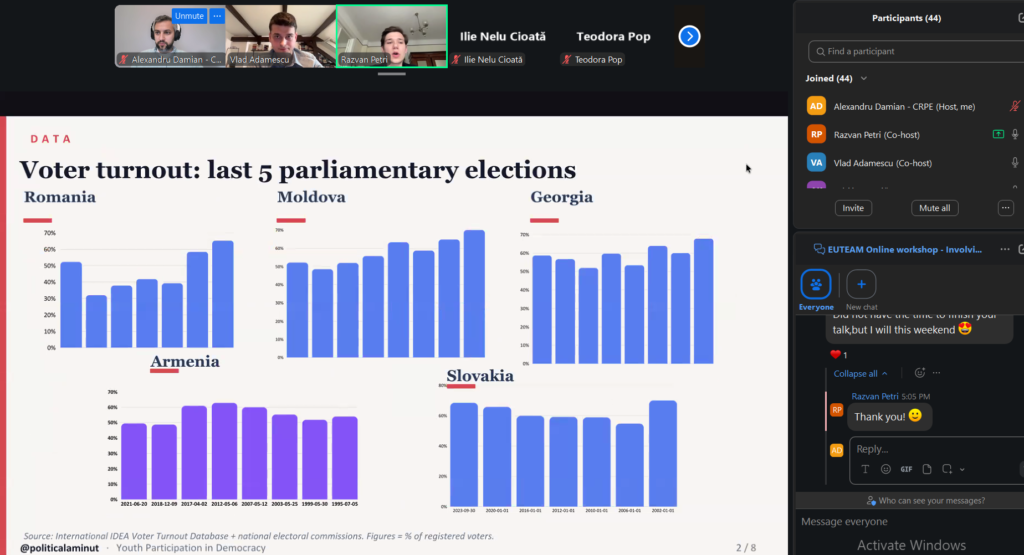
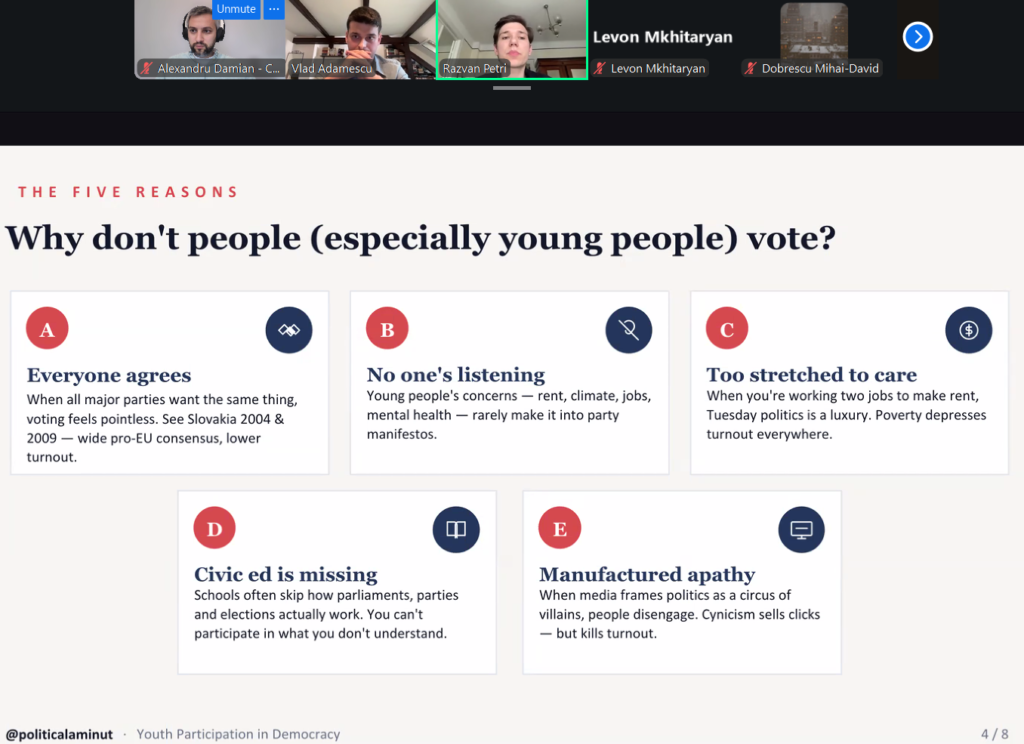
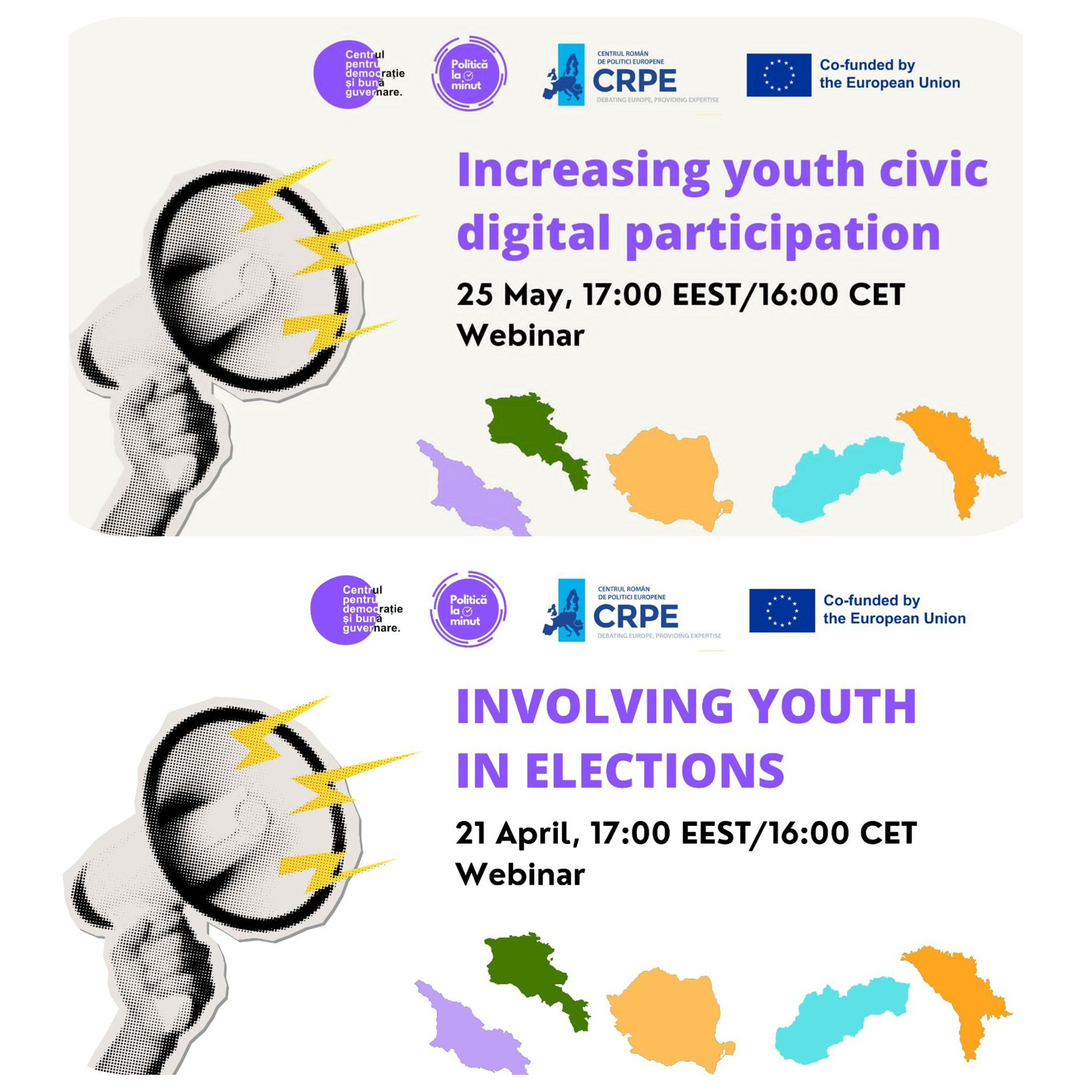
The first event, held on April 21st, explored the theme “Why Democracy? Why Involving?”, emphasizing how politics and civic involvement shape everyday life, from healthcare and education systems to broader social opportunities. Participants discussed youth electoral participation in Romania, Georgia, Armenia, Slovakia, and the Republic of Moldova, analyzing voter turnout trends and evidence showing that voting in one’s first elections significantly increases the likelihood of long-term civic participation. Young participants reflected on why youth often disengage from voting, identifying factors such as the perception that political parties are too similar, feelings that young voices are ignored, civic education gaps, social fatigue, and a “manufactured apathy.”
The session also emphasized that democracy extends beyond elections and includes everyday civic action, highlighting examples of youth engagement from across partner countries and the essential role of civil society organizations as watchdogs, educators, and bridges between communities.
In the end, the youths were invited to design their own civic-oriented social media pages as a practical exercise in civic engagement.
Exploring Democracy in the Digital Era
The second event, held on May 25th, focused on increasing youth civic digital participation through an interactive webinar examining democracy, civic engagement, and digital participation. Speakers discussed different democratic models, the importance of democratic institutions, checks and balances, and the growing phenomenon of democratic backsliding. Participants explored how democracy requires continuous engagement through accountability, peaceful protest, and active civic participation rather than participation limited to elections every four or five years.
Digital Tools for Civic Engagement
The webinar further explored the role of civil society, youth disengagement, and the opportunities offered by digital participation. Through examples such as Estonia’s e-voting system, participatory budgeting initiatives in Timișoara, online consultations, and the case study of Politică la minut, speakers highlighted how digital platforms can make civic participation more accessible to younger generations. Discussions also focused on making civic communication more accessible, encouraging young people to identify public problems, advocate for solutions, and use digital tools to strengthen democratic participation and community engagement.
The webinars were attended by more than 60 youths from Romania, Georgia, Armenia, Slovakia and the Republic of Moldova.
The webinars are part of EUTEAM project (Youth learning and living European values through virtual exchanges and gamification) led by CRPE. As part of the project, we are working with more than 2000 youths in 5 EU and non-EU countries on topics such as civic engagement, media literacy, diversity and antidiscrimination. Each youth was part of several webinars on the above mentioned themes, while we have received 77 youth-led action plans that were designed to make a change in their communities. In the Youth-led civic initiatives: Inspiring stories for schools and local communities report, we present some of these civic initiatives conceived, led and implemented by youths. We hope they can serve as inspiration and practical examples for other youths, schools, local administrations, civil society organizations, or informal groups who want to get involved.
——————————
Funded by the European Union. Views and opinions expressed are however those of the author(s) only and do not necessarily reflect those of the European Union or the European Education and Culture Executive Agency (EACEA). Neither the European Union nor the granting authority can be held responsible for them.