

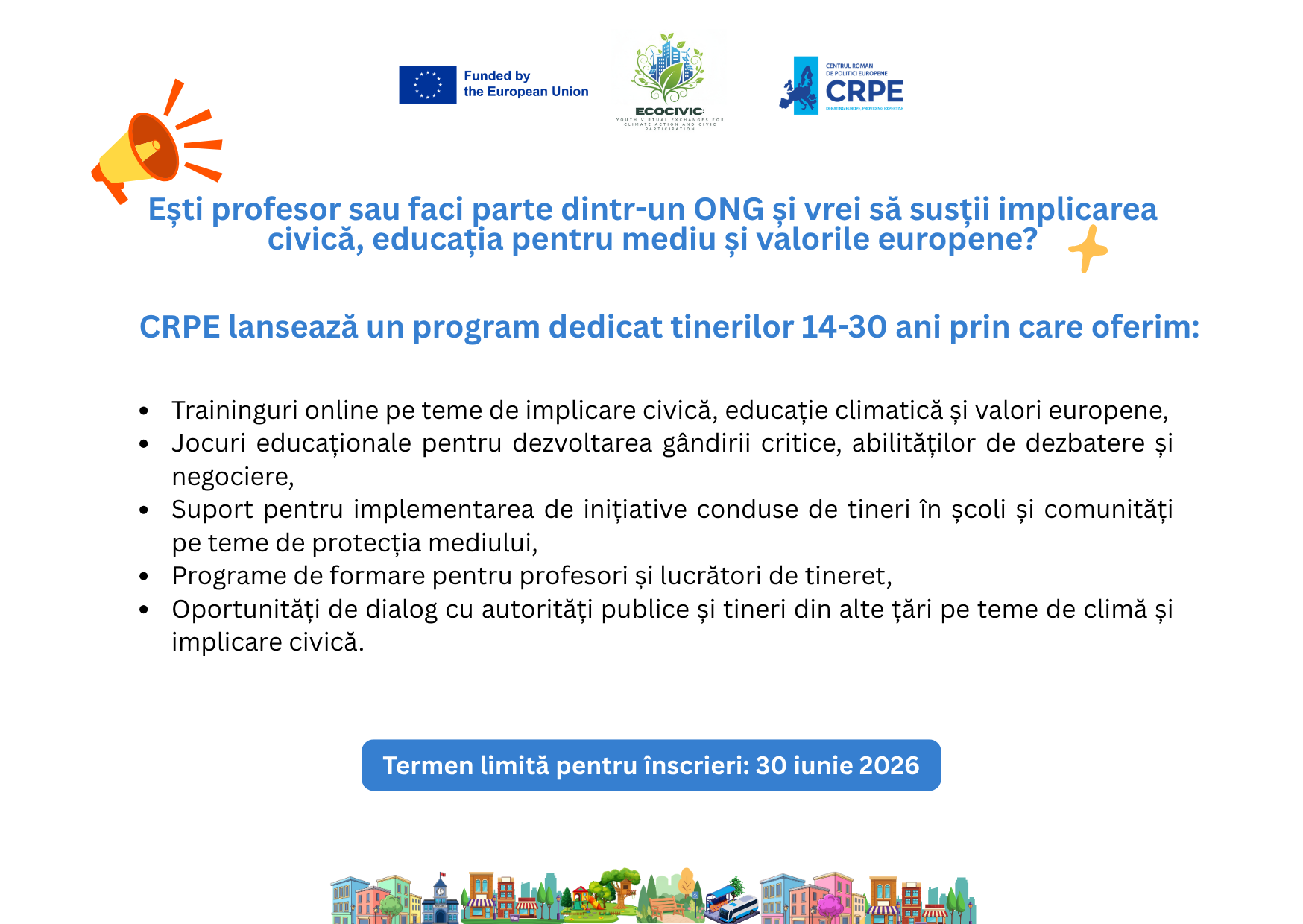
Are you a teacher or part of an NGO and want to support civic engagement, environmental education and European values?
The EcoCivic project offers young people from Romania, the Republic of Moldova, Armenia and Luxembourg the opportunity to discuss and address the environmental challenges facing their communities.
What is EcoCivic?
The EcoCivic project promotes educational programmes for young people that will help develop skills such as civic activism, critical thinking, environmental education and intercultural dialogue.
Young people will benefit from:
- An online training programme on environmental education and civic engagement;
- The development of action plans and funding for small-scale civic initiatives at school and community level;
- A gaming session using the educational board game Ecoville;
- Interactive learning sessions for young people through a mentoring programme;
- Virtual exchange programmes bringing together young people from different countries to collaborate and learn together.
By the end of the project, we aim to support more than 400 young people in Romania, primarily from small urban areas, in developing their civic engagement skills and understanding of the environmental issues affecting their communities.
Who can apply?
- Teachers, youth workers and representatives of NGOs or youth groups who wish to involve and support their students or beneficiaries (aged 14–30).
- Schools and NGOs that will benefit from specialised training sessions designed to provide teachers and youth workers with interactive teaching skills and methods related to active citizenship, media literacy and intercultural dialogue.
We particularly encourage applications from schools, NGOs and youth groups from small urban areas or those working with marginalised or underserved communities in terms of civic participation.
Selection criteria
Participants will be selected based on the following criteria:
- Commitment to engaging students and young people. Schools, teachers and youth NGOs must demonstrate a strong commitment to supporting youth engagement through these learning sessions and virtual exchanges.
- Geographical distribution. Priority will be given to schools and youth organisations from small urban areas, as well as those working with marginalised youth communities.
- Balanced representation. We aim to ensure a diverse group of participants, with balanced representation in terms of gender, geographical area and organisational profile.
- Availability to participate throughout the project. Selected schools and NGOs must be actively involved in all stages of the project, including virtual sessions and the mentoring programme (2026–2028).
Programme timeline: Training programmes will take place between September 2026 and September 2027 and will be followed by civic activities, mentoring sessions and funding for small-scale civic initiatives between September 2027 and June 2028. All project sessions and activities will be agreed together with the selected participants.
How to Apply
Youth NGOs, groups and schools interested in participating in learning sessions and virtual exchanges are invited to complete the following form: https://shorturl.at/nbBMZ
Please include the following information:
- Information about your school, youth group or NGO: provide information about your institution or organisation, including your interest in the programme and the learning objectives for your students and young people;
- Number of students who will be involved: indicate how many students you plan to involve in the project;
- Students’ ages: specify the age range of the students you would like to involve.
Applications will be assessed on a rolling basis, so we encourage you to submit your application as early as possible. We will then coordinate the programme stages together.
Application deadline: 30 June 2026
For any questions, please contact us at office@crpe.ro.
Why participate?
- Improve your knowledge. Take part in training sessions designed to strengthen your teaching skills in civic and environmental education.
- Encourage youth engagement: gain resources and knowledge to support young people in your classroom or community to actively participate in civic life.
- Expand your network: collaborate with teachers and youth workers from other countries, exchange good practices and build professional connections that will benefit your organisation and community.
- Support European values: play a direct role in promoting European values such as intercultural dialogue, diversity and active citizenship among young people in your region.
The EcoCivic project is funded by the European Union. The views and opinions expressed are solely those of the author(s) and do not necessarily reflect those of the European Union or the European Education and Culture Executive Agency (EACEA). Neither the European Union nor the granting authority can be held responsible for them.