

CRPE is publishing one of the most extensive studies conducted in recent years on the experience of students in Romania’s agricultural education system.
The report “The Educational Experience of Final-Year Students – An Analysis of Pre-University Agricultural Education” is based on a questionnaire administered to 902 students from 31 agricultural high schools across the country and addresses the question: “Do agricultural high schools succeed in preparing and retaining the next generation of agricultural professionals in the sector?”
Agricultural high schools are not usually students’ first choice. But they manage to “win them over” along the way
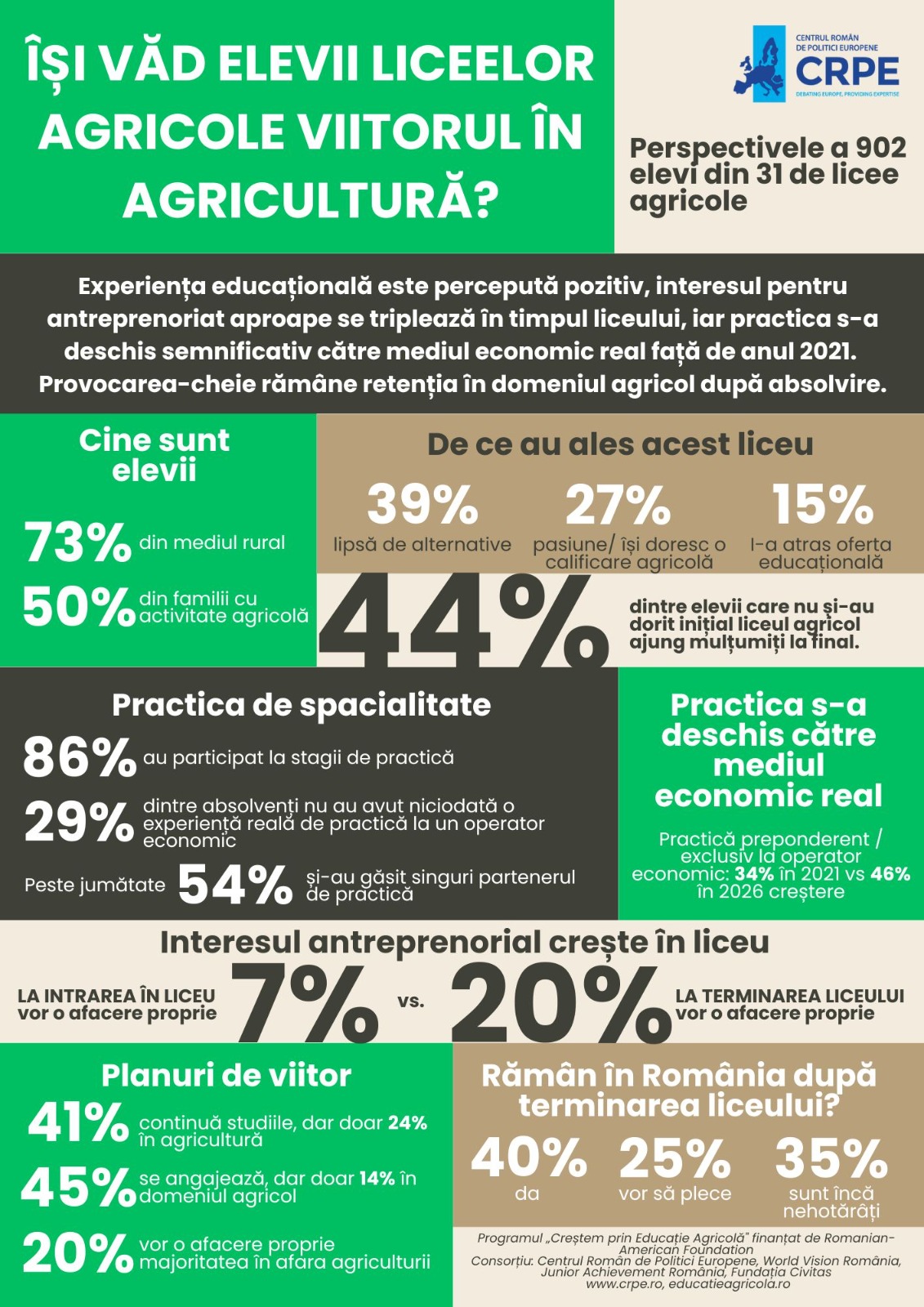
39% of the students surveyed say that the agricultural high school was not among their first choices when applying. Nevertheless, the majority report being satisfied with their chosen study track, and the educational experience is generally assessed positively.
This suggests that the main issue is not necessarily what happens within the school, but rather the difficulty agricultural high schools face in positioning themselves as an attractive choice for students and parents.
Work-based learning at companies is more widespread than in the past (46% in 2026 compared to 34% in 2021)
The report points to a positive development compared to previous studies: an increasing number of students are undertaking work placements with economic operators. However, almost 3 in 10 students graduate from high school without ever having had a real work-based learning experience on a farm.
Moreover, more than half of the students say they found their own work placement, while 37% believe there is a gap between what they learn at school and what is expected of them during their placements.
The major challenge: retaining young people in agriculture
Perhaps the most important conclusion of the study is that very few students see their professional future in agriculture.
Only 24% of those who intend to continue their studies choose an agricultural or related field, while among those who plan to enter the workforce, only 14% want a job in agriculture.
In other words, although half of the respondents come from families involved in agriculture and most study in an agricultural track, the system has not yet succeeded in turning this educational experience into a sufficiently attractive career option.
There are also reasons for optimism
Interest in entrepreneurship increases throughout the years of study. While only 7% of students say they initially chose an agricultural high school because they wanted to start a business, by the end of their studies, 20% say they want to become entrepreneurs.
This shows that schools can influence young people’s aspirations. The challenge is to support these aspirations through more relevant practical experience, meaningful contact with the business community and professional development opportunities.
The full report can be accessed here. The full infographic accompanying the article can be found here.
This study is part of the “Growing through Agricultural Education” (CEA) programme, funded by the Romanian-American Foundation (RAF) and implemented since 2015 by a consortium comprising the Romanian Center for European Policies, World Vision Romania Foundation, Junior Achievement Romania and Civitas Foundation for Civil Society Cluj. Over the past 10 years, CEA’s efforts have focused on supporting agricultural high schools in becoming (again) relevant educational hubs for the next generation of farmers. Today, more than 50 agricultural technical high schools across the country benefit from the support and know-how of the organisations involved in the programme.