

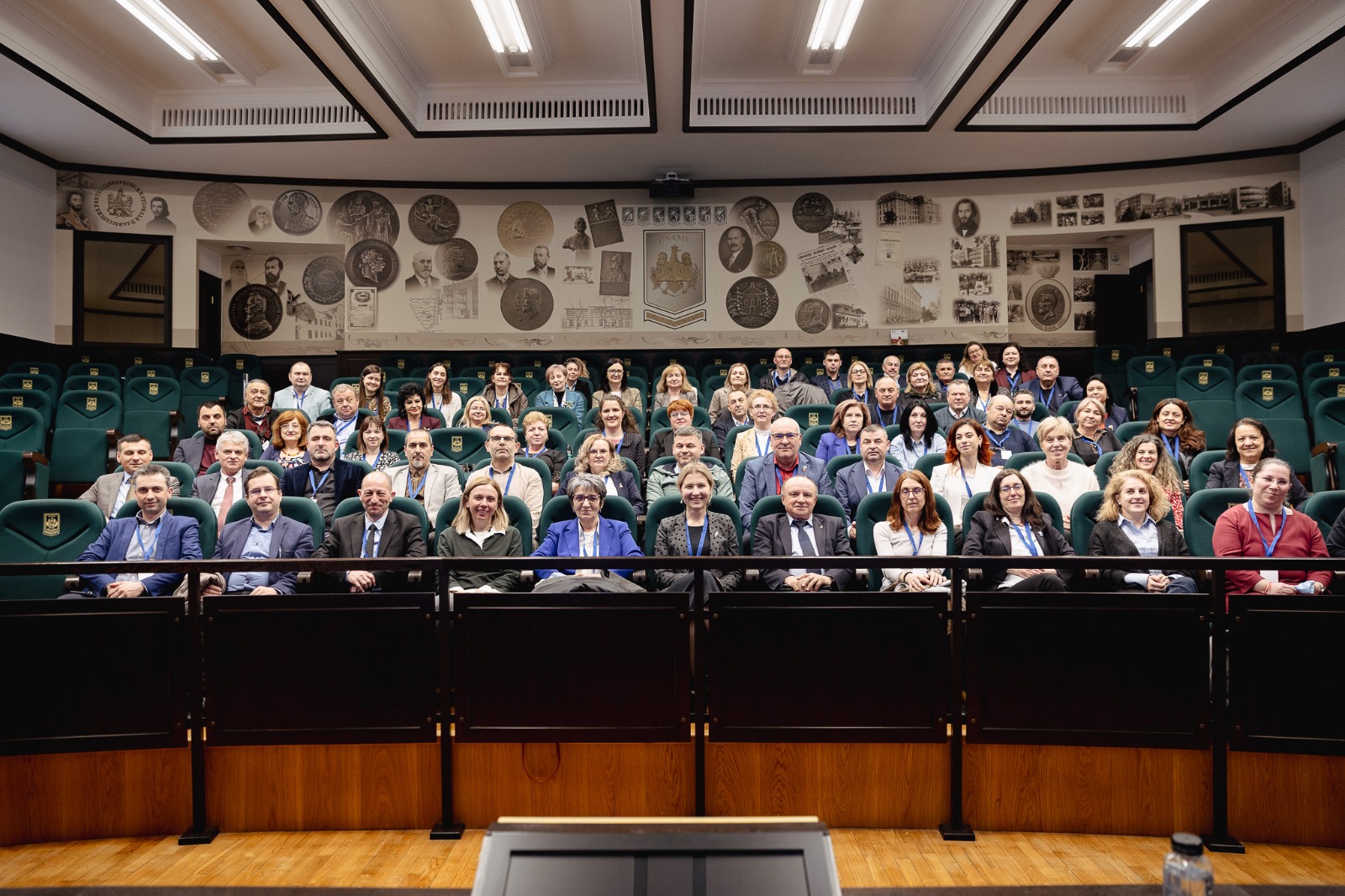
For three days, in Bucharest and Brănești, more than 65 principals and teachers from 41 agricultural high schools in Romania met with 20 representatives of agricultural education institutions, ministries, and farmers’ associations from the Republic of Moldova, alongside other universities, ministries, and public institutions, to discuss how to modernize agricultural education on both sides of the Prut River.
This is the second year we have convened in this format—and the connections are already beginning to take shape. We have built a community of principals and teachers who collaborate, learn from one another, and share both their challenges and their solutions.
Day 1 – The future of agriculture is already here
The first day took us to the Faculty of Biotechnical Systems Engineering at the National University of Science and Technology Politehnica Bucharest, where teachers saw firsthand what high-tech agriculture looks like: robots that sow and irrigate autonomously, agricultural machinery connected through IoT, and students programming neural networks for agricultural equipment.
We discovered fascinating research projects that need to reach communities, high schools, and the parents of middle school students, in order to firmly move beyond the outdated notion of “I won’t let my child end up tending cows”. Today’s “tending cows” is an extraordinary combination of life sciences, technology, and passion—and these ideas need to be heard as widely as possible.

Day 2 – Schools, universities, and real-world agriculture
On March 12, hosted by the University of Agronomic Sciences and Veterinary Medicine of Bucharest, discussions focused on how to better connect agricultural education with real-world agriculture and with the public policies shaping its future.
Participants explored the role of agricultural universities in supporting high schools, the place of agricultural education in the future Common Agricultural Policy post-2028, as well as the changes being prepared by the Ministry of Education for vocational and technical education—from new curriculum frameworks to the expansion of dual education in agriculture.
At the same time, discussions addressed many aspects of schools’ day-to-day realities: how to organize student internships, how to build partnerships with farms and companies, how to attract projects and funding, and how schools can become relevant actors in local agricultural ecosystems, alongside key institutions and the private sector.
Agricultural universities from several academic centers also emphasized the need for much closer collaboration between universities and high schools and put forward opportunities and ideas in this regard—including granting students access to campuses, laboratories, and teaching farms.

Day 3 – Romania and the Republic of Moldova: shared challenges, emerging partnerships
On March 13, we moved to the “Cezar Nicolau” Technological High School in Brănești, together with the delegation from the Republic of Moldova.
Representatives of the Ministry of Education of the Republic of Moldova presented the development directions for technical and vocational education, while the Ministry of Agriculture and Food Industry highlighted the importance of integrating agricultural education into rural development policies.
Our partners in the Farmkeen project presented the successful implementation of a blended learning platform designed to organize practical training and develop students’ digital skills in two agricultural schools in the Republic of Moldova, along with the project’s other components.

After three days of discussions, the central idea is clear: if we want a new generation of farmers, we must invest not only in farms, but also in the schools that train them—and better connect these schools with universities, farmers, and the technologies transforming agriculture.
We thank everyone who contributed to this meeting. Together, we are growing the next generation of farmers.

The event was organized by the Romanian Center for European Policies (CRPE) as part of the “Growing through Agricultural Education” program, implemented together with World Vision Romania, Civitas Foundation for Civil Society, and Junior Achievement Romania. It also included activities carried out within the FARMKEEN project, implemented by CRPE with the support of its partners from the Netherlands (Aeres), Romania (WorldSkills), and the Republic of Moldova (CEDA).